οκ απο οτι διαβαζω η ψεκασμενη εχει αυτο το ιστορικο οι προγονοι της
ειναι σχεδον απο παντου ηπειρο μικρα ασια θρακη μακεδονια και απο ενα νησι
αλλα δεν θυμαμαι ποιο -που σημαινει οτι αν δωσει το DNA για αναλυση
θα τρελαθει ο μετρητης ---
Σύγκριση γενεαλογικών εξετάσεων DNA
-
nemo

- Supreme poster

- Δημοσιεύσεις: 17147
Re: Σύγκριση γενεαλογικών εξετάσεων DNA
0 .
το απόλυτο ένα που συχαίνομαι είναι οι αυταπάτες
επειδη είναι και ο λόγος της ύπαρξής μου
επειδη είναι και ο λόγος της ύπαρξής μου
-
Adminović

- Sloboda Narodu

- Δημοσιεύσεις: 15534
- Τοποθεσία: F.R. Liberland
Re: Σύγκριση γενεαλογικών εξετάσεων DNA
nemo έγραψε:οκ απο οτι διαβαζω η ψεκασμενη εχει αυτο το ιστορικο οι προγονοι της
ειναι σχεδον απο παντου ηπειρο μικρα ασια θρακη μακεδονια και απο ενα νησι
αλλα δεν θυμαμαι ποιο -που σημαινει οτι αν δωσει το DNA για αναλυση
θα τρελαθει ο μετρητης ---
Άντε, κάνε κι εσύ κάνα τεστ να δούμε τί είσαι...

0 .
Ο ψεκασμός είναι υγεία, είναι πολιτισμός!
Σκοτώνει βακτήρια, ιούς, μύκητες, ζιζάνια, καθώς και πάσης φύσεως παράσιτα.
Σκοτώνει βακτήρια, ιούς, μύκητες, ζιζάνια, καθώς και πάσης φύσεως παράσιτα.
-
Λαχουρένιος

- Ultimate Stalker
- Δημοσιεύσεις: 49562
- Τοποθεσία: Γεφυρα
-
nemo
- Supreme poster
- Δημοσιεύσεις: 17147
Re: Σύγκριση γενεαλογικών εξετάσεων DNA
κατευθειαν απο τους μυρμιδονες το αρχαιοτερο φυλο των ελληνων
0 .
το απόλυτο ένα που συχαίνομαι είναι οι αυταπάτες
επειδη είναι και ο λόγος της ύπαρξής μου
επειδη είναι και ο λόγος της ύπαρξής μου
-
Προέλλην

- Right to Repair Champion
- Δημοσιεύσεις: 20926
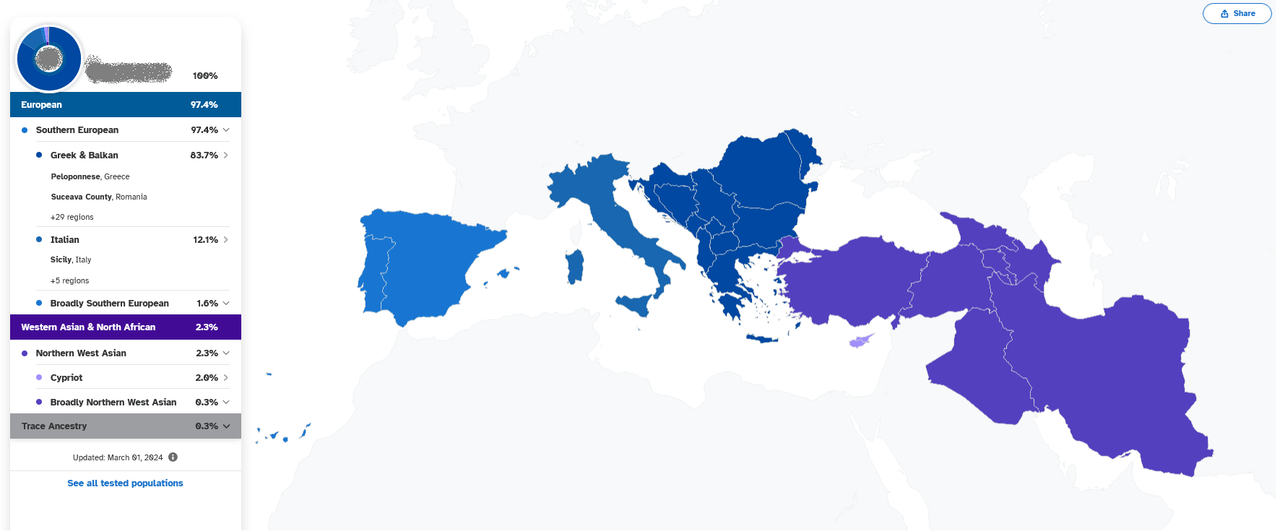
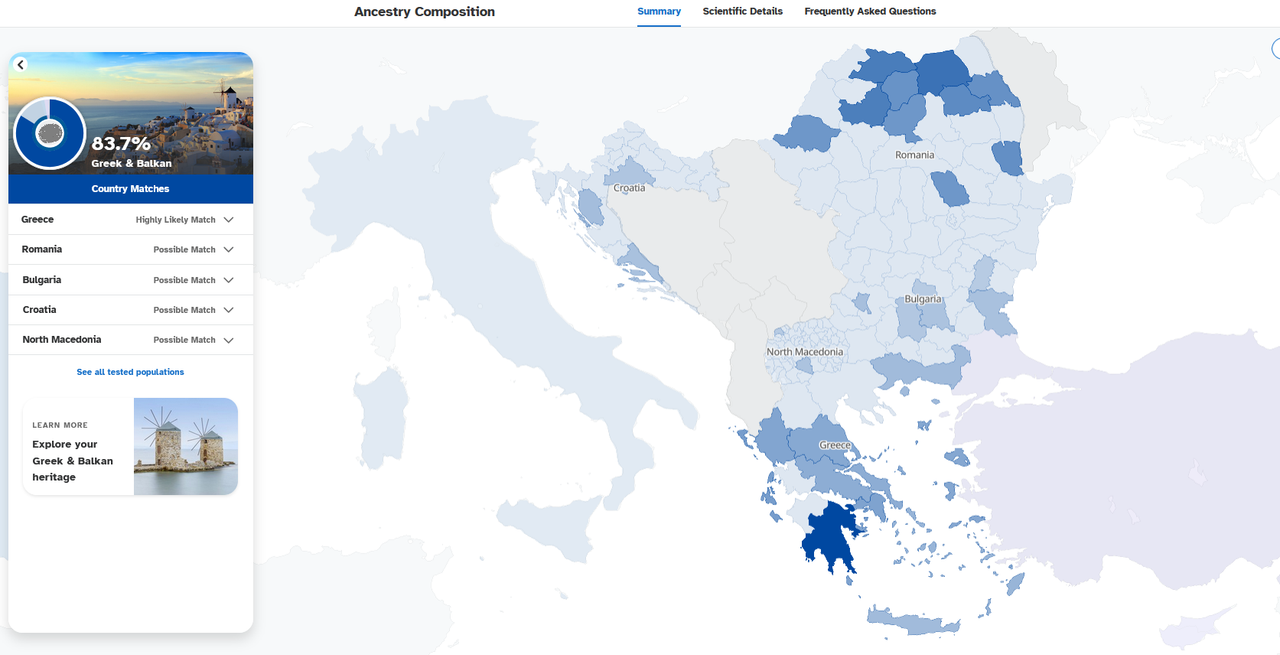

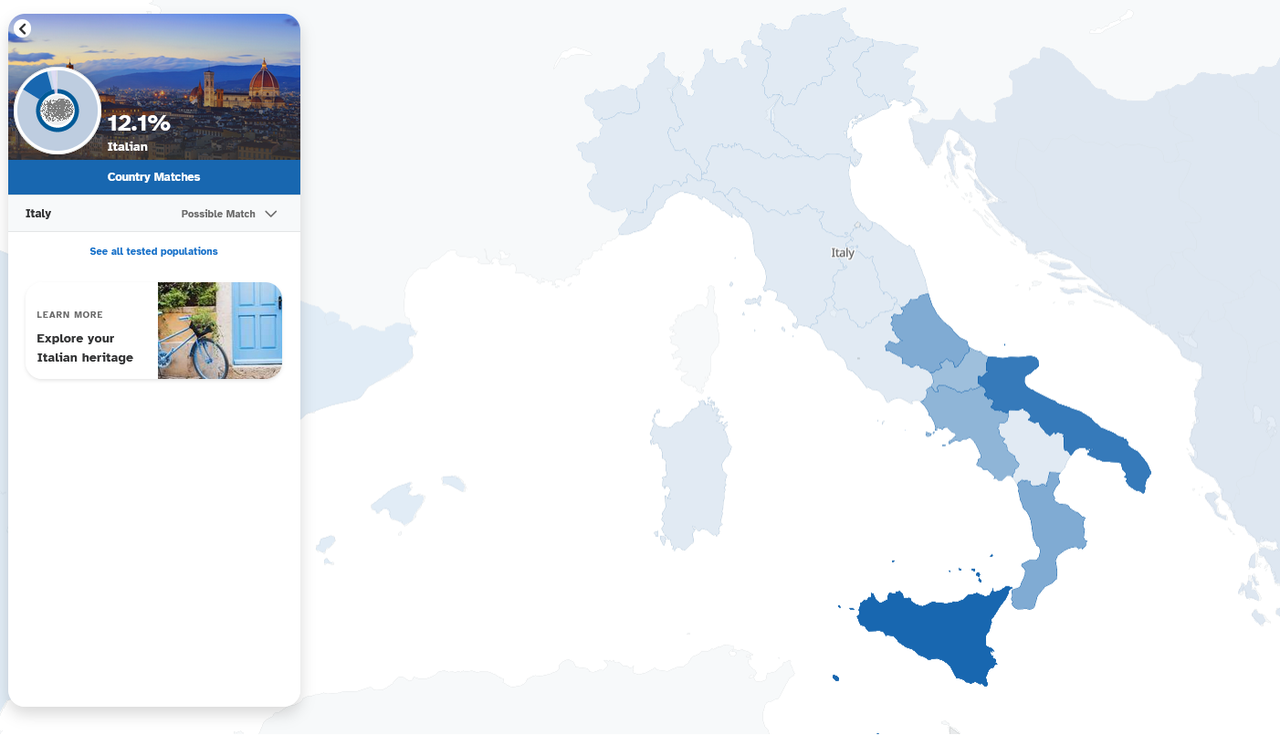
-
Προέλλην
- Right to Repair Champion
- Δημοσιεύσεις: 20926
Re: Σύγκριση γενεαλογικών εξετάσεων DNA
[img]preview%20expired[/img]
YΠΕΡ-Προέλληνας;;;
Η πατρογονική μου γραμμή δεν άλλαξε τα τελευταία 11.000 χρόνια. Λαθρο-IE, στις τρύπες σας, εδώ ΝΤΟΠΙΟΣ
Της μάνας μου το σόι πέρασαν από Καυκάζ, Προελλάδα, Κροατία και έφτασαν μέχρι Γαλλία.
Από την Εδέμ απευθείας στην Προελλαδίτσα ΜΑΣ
YΠΕΡ-Προέλληνας;;;
Η πατρογονική μου γραμμή δεν άλλαξε τα τελευταία 11.000 χρόνια. Λαθρο-IE, στις τρύπες σας, εδώ ΝΤΟΠΙΟΣ
Της μάνας μου το σόι πέρασαν από Καυκάζ, Προελλάδα, Κροατία και έφτασαν μέχρι Γαλλία.
Από την Εδέμ απευθείας στην Προελλαδίτσα ΜΑΣ
0 .
-
Προέλλην
- Right to Repair Champion
- Δημοσιεύσεις: 20926
Re: Σύγκριση γενεαλογικών εξετάσεων DNA
Τα ανεβάζω και Heritage, Ancestry και GEDmatch. Είμαι περίεργος να δω τι διαφορές θα βγάλουν απο το άλλο kit (της Ancestry).
0 .
-
Προέλλην
- Right to Repair Champion
- Δημοσιεύσεις: 20926
Re: Σύγκριση γενεαλογικών εξετάσεων DNA
Origins & History
Assimilation of Neolithic European E-V13 by the Indo-Europeans
For many years the vast majority of academics have assumed that E-V13 and other E1b1b lineages came to the Balkans from the southern Levant via Anatolia during the Neolithic, and that the high frequency of E-V13 was caused by a founder effect among the colonisers. This theory has it that E1b1b people were associated with the development of Neolithic lifestyle and the advent of agriculture in the Fertile Crescent and its earliest diffusion to Southeast Europe (Thessalian Neolithic
Nowadays E-V13 is the only Mediterranean haplogroup consistently found throughout Europe, even in Norway, Sweden, Finland and Baltic countries, which are conspicuous by the absence of other Neolithic haplogroups like G2a (bar the Indo-European G2a-Z1815), J1 and T (except in Estonia). However, since G2a is the only lineage that was consistently found in all Neolithic sites tested to date in Europe, the absence of Neolithic G2a lineages from Scandinavia and the Baltic implies that no Neolithic lineage survives there, and consequently E-V13 does not date from the Neolithic in the region.
In fact, it has been calculated that E-V13 emerged from E-M78 some 7,800 years ago, when Neolithic farmers were advancing into the Balkans and the Danubian basin. Furthermore, all the modern members of E-V13 descend from a common ancestor who lived approximately 5,500 years ago, and all of them also descend from a later common ancestor who carried the CTS5856 mutation. That ancestor would have lived about 4,100 years ago, during the Bronze Age. Almost immediately afterwards, CTS5856 split into six subclades, then branched off into even more subclades in the space of a few generations. In just a few centuries, that very minor E-V13 lineage had started an expansion process that would turn it into one of Europe's most widespread paternal lineages and reach far beyond the borders of Europe itself, also spreading to the eastern edge of the Mediterranean, the Caucasus, Kurdistan, Iran, and even Siberia.
This data suggests that the fate of E-V13 was linked to the elite dominance of Bronze Age society
What is surprising with E-V13 is that it is as common in R1a-dominant as in R1b-dominant countries. R1a Indo-European tribes are associated with the Corded Ware culture, which spanned across Northeast Europe, Scandinavia and the northern half of Central Europe. R1b tribes invaded the Balkans, the southern half of Central Europe, and joined up with Corded Ware people in what is now Germany, the Czech Republic and western Poland. If E-V13 was found among both groups, it would have needed to be either assimilated in the Pontic Steppe or very near from it (say, in the Cucuteni-Trypillian culture, around western Ukraine, Moldova and Romania), or at the junction between the two groups in central Europe (e.g. around the Czech Republic).
The distribution and age of E-V13 clades in central and western Europe are consistent with a dispersal by Hallstatt and La Tène Celts, Italic tribes (including a Roman redistribution) and the later influx of Germanic tribes, particularly the Goths, who may have assimilated additional Proto-Slavic E-V13 lineages in East Germany, Poland and Ukraine before entering the Roman Empire. (=> see also the discussions Was E-V13 a major lineage of Hallstatt Celts and Italics? and Ancient East, West and North Germanics had different Y-DNA lineages).
Amorim et al. (2018) tested the ancient DNA from 6th century Italy and Hungary and identified one E-V13 in Collegno (Turin) who was autosomally fully Italian (not a Lombard immigrant like many other samples tested).
The eastern advance of the Corded Ware culture eventually gave rise to the Sintashta culture in the Ural region, which is the ancestral culture of the Indo-Iranian branch of Indo-Europeans. E-V13's presence in this culture would explain why modern Iranians and Kurds possess E-V13, in addition to R1a-Z93 and R1b-Z2103. E-V13 has been found as far away as central Siberia, near the Altai, a region also known to have been settled by Bronze Age Indo-Europeans.
Due to the scarcity of full genomic sequences available from the Balkans, it is not yet clear when E-V13 expanded in that region. The Indo-European migrations would certainly have brought some E-V13 early on, from circa 2500 BCE. But the history of the region is so complex that there might be many separate branches of E-V13 that each came with a different invasion (e.g. Iranic tribes, La Tène Celts, Romans, Goths, Slavs). The first Indo-European migration to Greece was that of the Mycenaeans from c. 1650 BCE. The Dorians from Central Europe followed from c. 1200 BCE. Both could have brought different subclades of E-V13, and a founder effect or the phenomenon of elite dominance among the ruling invaders might have caused a fast growth of E-V13 lineage in Late Bronze Age and Iron Age Greece.
Και στους Γιαμνάδες, εμείς οι Αρχέγονοι είμασταν Η Ελίτ
There are at least three distinct sources of E-V13 in Italy. The first would be the Bronze Age Italic tribes from Central Europe, who in all logic would have possessed at least some E-V13 lineages before they invaded the Italian peninsula. Proto-Italics would have been a predominantly R1b-U152 tribe, but also carried a minority of E-V13, G2a-L140 (L13, L1264 and Z1816 subclades) and J2a1-L70 (PF5456 and Z2177 subclades). The second would be the ancient Greeks, who heavily colonized southern Italy from the 9th century BCE until the Roman conquest in the 3rd century BCE. The third are the Goths. As a Germanic tribe they might have carried a small percentage of E-V13. But that percentage very certainly increased after spending several centuries in Central and Southeast Europe and assimilating Proto-Slavs and Balkanic people before invading Italy. The Goths settled over all the Italian peninsula. They would have brought typically Germanic lineages like I1 and R1b-U106, but also the Proto-Slavic R1a-CTS1211, which is now found uniformly in 1 to 2% of the population. Since R1a-CTS1211 is not originally Germanic, it is likely that the Goths also brought a small but noticeable percentage of assimilated lineages from the Balkans, including E-V13 and J2b1 (I2a1b-CTS10228 would have come later from the East Slavic migrations from Ukraine during the Early Middle Ages, hence its absence from Italy, apart from a few coastal areas facing the Adriatic Sea).
An Indo-European dispersal of V13 subclades would not only explain why E-V13 is present in places like Finland, northwest Russia or Siberia, where Neolithic farmers had a negligible impact, but also why E-V13 is so conspicuously lacking from the Basque country and (central) Sardinia, the two regions of Europe with the highest Neolithic ancestry. Sardinia is also the only part of Europe where Bronze Age Steppe ancestry is virtually absent. The low percentage of E-V13 is coastal Sardinia would be better explained by more recent settlements on the island by the Romans, or even the Goths, who also settled in Sardinia.
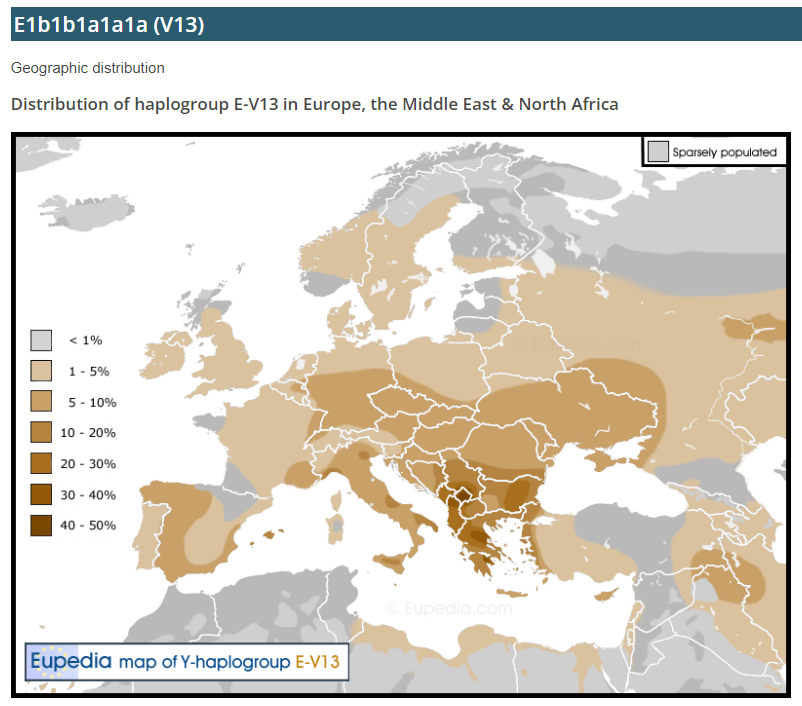
The small presence of E-V13 in the Near East could be better explained by the extremely long Greek presence in the eastern Mediterranean from the time of Alexander the Great until the end of the Byzantine domination over the region during the Middle Ages. It would be unthinkable that over 1,500 years of Hellenisation and Byzantine rule in Anatolia and the Levant didn't leave any genetic trace. In Anatolia, E-V13 is found mostly in the western third of the country, the region that used to belong to ancient Greece. The absence of E-V13 from Central Anatolia does not concord with a diffusion linked to Neolithic agriculture. There is clearly a radiation from the Greece (where E-V13 makes up approximately 30% of the paternal lineages) to the East Mediterranean (where the frequency drops to under 5%).
https://www.eupedia.com/europe/Haplogro ... -DNA.shtml
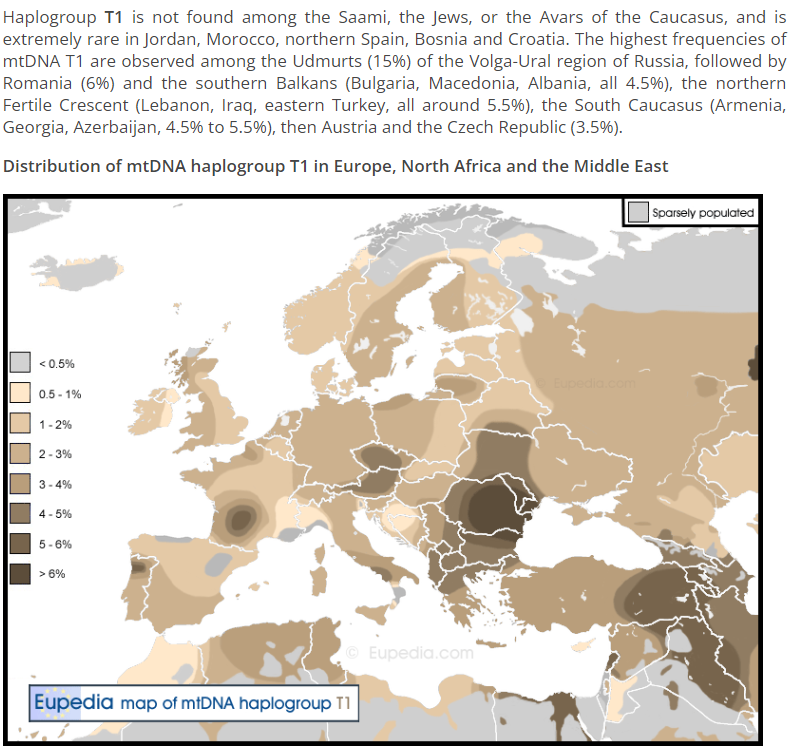
Distribution of mtDNA haplogroup T1 in Europe, North Africa and the Middle East
https://www.eupedia.com/europe/Haplogroup_T_mtDNA.shtml
0 .
-
Προέλλην
- Right to Repair Champion
- Δημοσιεύσεις: 20926
Re: Σύγκριση γενεαλογικών εξετάσεων DNA
nemo έγραψε:κατευθειαν απο τους μυρμιδονες το αρχαιοτερο φυλο των ελληνων
Θα σέβεσε λέμε τον πιστοποιημένο αυτόχθονα Νεολιθικό Θεσσαλό Ελίτ Προέλληνα

Δικός μας είσαι ρε ή κανένας Σλάβος;

0 .
-
Adminović
- Sloboda Narodu
- Δημοσιεύσεις: 15534
- Τοποθεσία: F.R. Liberland
Re: Σύγκριση γενεαλογικών εξετάσεων DNA
Πελοπόννησο βλέπω
, Σουτσεάβα Ρουμανία (Μολδαβία δηλαδή) , Σικελία.Κάποιος εδώ έχει νοτιοελλαδίτικη και μολδοβλάχικη καταγωγή.
Το haplogroup EV13 να πούμε κι ότι παρατηρείται κυρίως σε αλβανικούς πληθυσμούς.
Προέλλην έγραψε:Λαθρο-IE, στις τρύπες σας, εδώ ΝΤΟΠΙΟΣ
Λαθροέποικος από Αφρική.

0 .
Ο ψεκασμός είναι υγεία, είναι πολιτισμός!
Σκοτώνει βακτήρια, ιούς, μύκητες, ζιζάνια, καθώς και πάσης φύσεως παράσιτα.
Σκοτώνει βακτήρια, ιούς, μύκητες, ζιζάνια, καθώς και πάσης φύσεως παράσιτα.