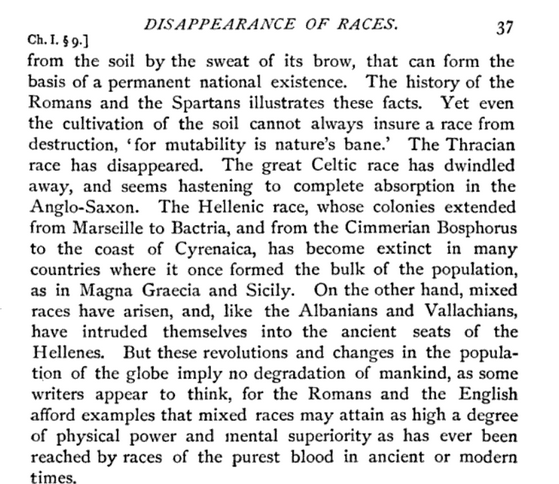
Από το βιβλίο "A History of Greece: Mediaeval Greece and the empire of Trebizond, A.D. 1204-1461." του George Finlay.
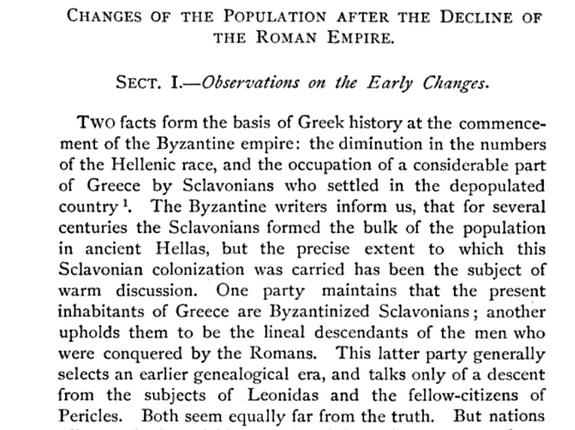
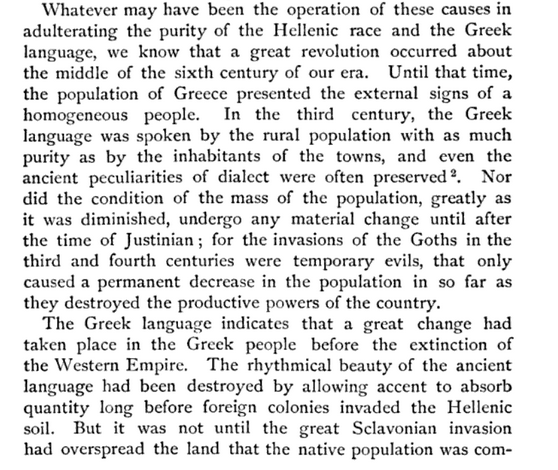
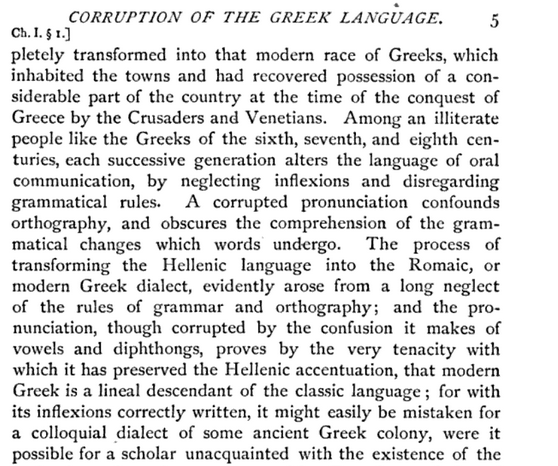
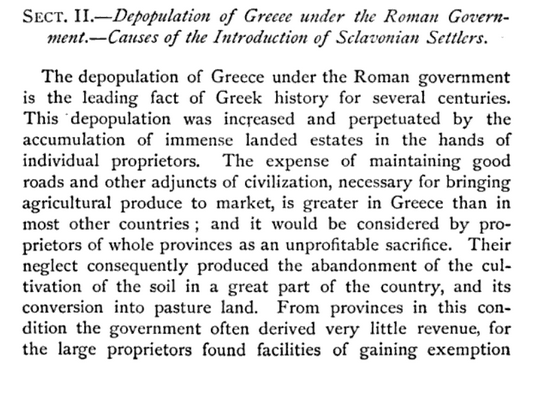
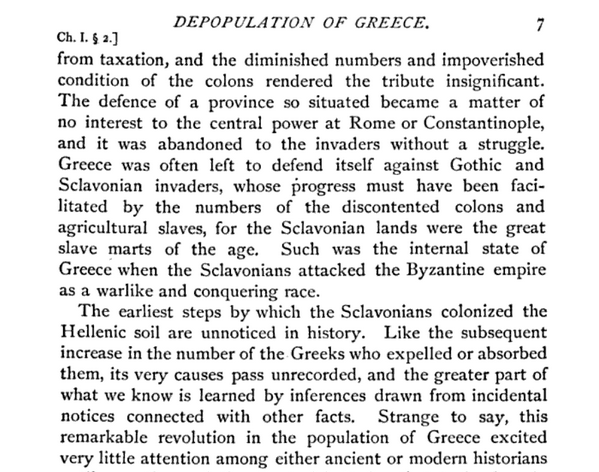
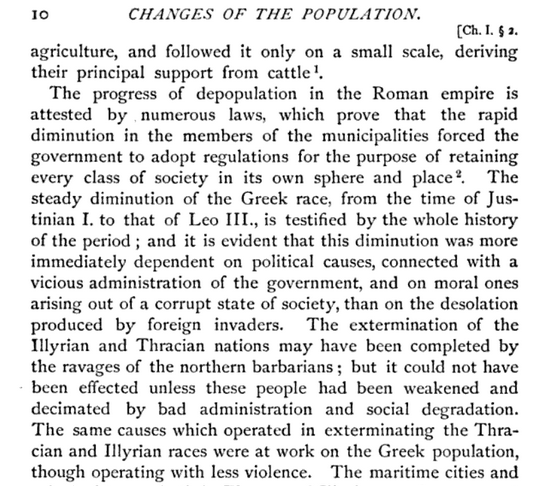
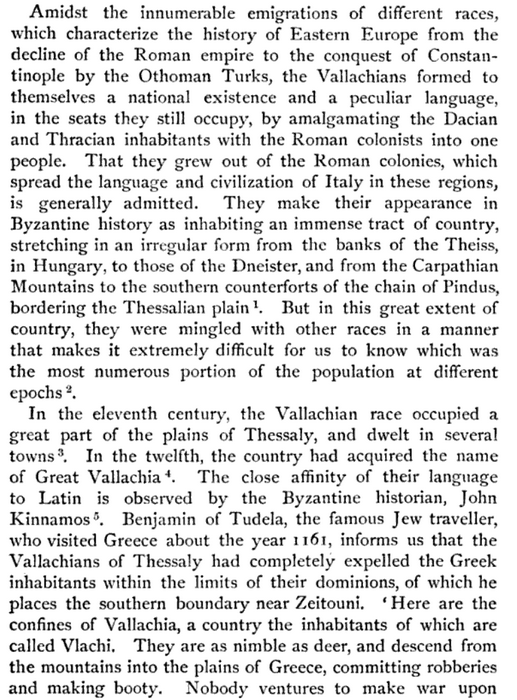
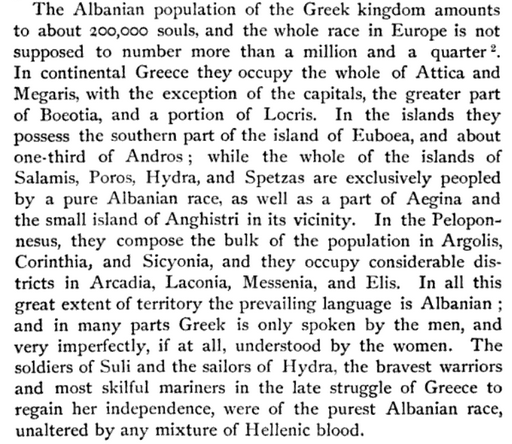
Αποσπάσματα που αναφέρονται στην απότομη μείωση του πληθυσμού της Ελλάδας που παρατηρήθηκε την εποχή του Ιουστινιανού και στους μετέπειτα αιώνες και την σταδιακή αντικατάσταση του πληθυσμού από Σλάβους, Βλάχους και Αλβανούς έποικους.
Adminović έγραψε:Από το βιβλίο "A History of Greece: Mediaeval Greece and the empire of Trebizond, A.D. 1204-1461." του George Finlay.
Αποσπάσματα που αναφέρονται στην απότομη μείωση του πληθυσμού της Ελλάδας που παρατηρήθηκε την εποχή του Ιουστινιανού και στους μετέπειτα αιώνες και την σταδιακή αντικατάσταση του πληθυσμού από Σλάβους, Βλάχους και Αλβανούς έποικους.
]
τα εχουμε ξαναπει αυτα πληθυσμοι που ξαναγυρνουν στην πατριδα αλβανοι =σχεδον το dna ειναι ο ιδιο με μας και αμα ψαξουμε και τους αλλους τα ιδια θα βρουμε
οι ξενοι περιηγητες εχουν γραψει και "τερατα
0 .
το απόλυτο ένα που συχαίνομαι είναι οι αυταπάτες επειδη είναι και ο λόγος της ύπαρξής μου
Αχ αυτοί οι ιστορικοί του 19ου αι. ! Αντί να βασίζονται στις πηγές έγραφαν ιστορία απ' το κεφάλι τους. Βέβαια όσοι σήμερα τους επικαλούνται είναι απλά γραφικοί.
0 .
Τους μεν κενούς ασκούς το πνεύμα διίστησι , τους δε ανοήτους ανθρώπους το οίημα. ( Σωκράτης [ στον Στοβαίο ] )
Θα ήταν μέγα σφάλμα να μην αναφερθούμε και στους Αρμένιους, τους Λαζούς και τους άλλους λαούς του Καυκάσου και της Ανατολίας, που αποτέλεσαν για αιώνες την κύρια πληθυσμιακή ομάδα του βυζαντινού κράτους και συχνά οι αυτοκράτορες (πολλοί εξ αυτών έχοντες οι ίδιοι αρμενική ή λαζική καταγωγή) μετατόπιζαν τέτοιους πληθυσμούς προς την ηπειρωτική Ελλάδα και τα νησιά, είτε γιατί αυτά είχαν ερημώσει είτε για να αποτελούν "εμπόδιο" στους εχθρούς του Βυζαντίου. Επώνυμα όπως πχ Βάρδας, Παγκράτης, Βαρδινογιάννης κλπ έχουν σαφώς αρμενική προέλευση.
Αυτό το ζήτημα το έχει μελετήσει εκτενώς ο Χαράνης και εδώ θα βάλουμε μερικά αποσπάσματα από το έργο του.
The Armenians in the Byzantine Empire
In his account of the revolt of Thomas the Slavonian (820--823) against the Emperor Michael II (820--829), the Byzantine historian Genesius lists a variety of peoples from whom the armies of the rebel had been drawn: Saracens, Indians, Egyptians, Assyrians, Medes, Abasgians, Zichs, Vandals, Getae, Alans, Chaldoi, Armenians, adherents of the heretical sects of the Paulicians and the Athinganoi (1). Some of these peoples are well known; the identity of others, despite efforts made to determine it, is by no means certain (2). But in any case, their listing by the Byzantine historian illustrates vividly the multiracial character of the Byzantine empire. This was in the ninth century, but the situation was not different for the period before and it would not be different for the period after. The Byzantine empire was never in its long history, a true national state with an ethnically homogeneous population.
Among the various ethnic groups in the Byzantine empire, the Armenians constituted one of the strongest. At the end of the sixth century the Byzantine empire controlled the major part of Armenia. The events of the seventh century, the rise of the Arabs in particular, deprived it of this control, but it still retained some Armenian-speaking lands. The expansion of the empire which began late in the ninth century greatly increased the extent of these lands. By the middle of the eleventh century, all Armenia was in Byzantine hands, though shortly afterwards it was permanently lost to the Seljuk Turks.
[...]
Many Armenians came into the Byzantine empire even when Armenia was under foreign control. They came sometimes as adventurers, but more often as refugees. Thus in 571, following an unsuccessful revolt against the Persians, numerous Armenian noblemen, headed by Vardan Mamikonian and accompanied by the Armenian Catholicus and some bishops, fled to Constantinople (3). Vardan and his retinue entered the Byzantine army; the rest seem to have settled in Pergamon where an Armenian colony is known to have existed in the seventh century. It was from this colony that Bardanes came who, as Phillipicus, occupied the imperial throne from 711 to 713 (4).
The religious ferment in Armenia which in the seventh century gave rise to the Paulician sect had the effect of bringing more Armenians into the Byzantine empire. Armenian Paulicians, driven from their homes sometime before 662, settled in the empire, especially in the region of the junction of the Iris and the Lycus rivers in the territories of the Pontus. Their settlements extended almost as far as Nicopolis (Enderes) and Neocaesarea (Niksar) (5). These were regions where the Armenian element was already considerable. Comana, for instance, is referred to by Strabo as the market of the Armenians (6).
[...]
The Armenians, however, did not always come willingly. They were sometimes forcibly removed from their homes and settled in other regions of the empire. Justinian had already resorted to this practice, but the numbers involved were small, perhaps a few families (11). Transplantations on a large scale took place during the reigns of Tiberius and Maurice. In 578, 10,000 Armenians were removed from their homes and settled in the island of Cyprus. "Thus", says Evagrius, "land, which had been previously untilled, was everywhere restored to cultivation. Numerous armies also were raised from among them that fought resolutely and courageously against the other nations. At the same time every household was completely furnished with domestics, on account of the easy rate at which slaves were procured" (12).
A transplantation on a vaster plan was conceived by Maurice and it was partially carried out. Maurice, who may have been of Armenian descent, though this is extremely doubtful (13), found the Armenians extremely troublesome in their own homeland. The plan which he conceived called for the cooperation of the Persian king in the removal from their homes of all Armenian chieftains and their followers. According to Sebeos, Maurice addressed the Persian king as follows: The Armenians are "a knavish and indocile nation. They are found between us and are a source of trouble. I am going to gather 'mine and send them to Thrace; [15] send yours to the East. If they die there, it will be so many enemies that will die; if, on the contrary, they kill, it will be so many enemies that they will kill. As for us, we shall live in peace. But if they remain in their country, there will never be any quiet for us". Sebeos further reports that the two rulers agreed to carry out this plan, but apparently the Persians failed to cooperate, for when the Byzantine emperor gave the necessary orders and pressed hard for their execution, many Armenians fled to Persia (14). The Byzantines, however, did carry out the deportation, though only in part. In ordering this removal, Maurice's real motive was, no doubt, the fact that he needed the Armenians as soldiers in Thrace.
Further deportations and settlement of Armenians in the Byzantine empire, especially in Thrace, are attested for the eighth century. During the reign of Constantine V Copronymus, thousands of Armenians and monophysitic Syrians were gathered by the Byzantine armies during their raids in the regions of Germanicea (Marash), Melitene and Erzeroum and were settled in Thrace (15). Others, also from the environs of Erzeroum, were settled along the eastern frontiers. These, however, were subsequently seized by the Arabs and were settled by them in Syria (16). During the reign of Leo IV, a Byzantine raiding expedition into Cilicia and Syria resulted in the seizure of thousands of natives, 150,000 according to one authority, who were settled in Thrace (17). These, however, were chiefly Syrian Jacobites, though some Armenians may have also been included. Many of the Armenians settled in Thrace were seized by the Bulgar Krum (803--814) and carried away, but most of them eventually returned. According to tradition, the parents of the future Emperor Basil I and Basil himself were included among these prisoners, but there is reason to doubt the historical accuracy of this tradition (18).
The diverse ethnic groups established in Thrace were reinforced by later arrivals. In the tenth century, during the reign of John Tzimiskes, a considerable number of Paulicians were removed from the frontier regions of the east and were settled in Thrace, more exactly in the country [16] around Phillippopolis (19). These Paulicians were most probably predominantly Armenians. A little later, perhaps in 988, Armenians were settled also in Macedonia. They were brought there from the eastern provinces of the empire by Basil II in order to serve as a bulwark against the Bulgarians and also to help increase the prosperity of the country (20).
Meanwhile, other Armenians had been settled elsewhere in the empire. Nicephorus I used Armenians, among others, in his resettlement of Sparta at the beginning of the ninth century (21). Some time earlier, about 792, an unsuccessful revolt among the Armeniacs, a corps which was no doubt predominantly Armenian, led to the settlement of a thousand of them in Sicily and other islands (22). In 885 Nicephorus Phocas, grandfather of the tenth century Emperor by the same name, settled a multitude of Armenians in Calabria. These, as Gregoire suggests, may have been of the Paulician faith as Tephrike, the stronghold of that sect, had fallen to the imperial forces only a few years before and the Paulicians had been dispersed (23). Armenians, among others, were also settled in Crete following the recovery of that island in 961 by Nicephorus Phocas, the future Emperor (24). Two Armenian military settlements are known to have existed in western Asia Minor in the tenth century. These were the settlements at Prine and Platanion, which, according to Constantine Porphyrogenitus, furnished a number of Armenian troops in the expedition against Crete during the reign of Leo VI. Armenians, settled in the Thracesian theme, also participated in the expedition against Crete in 949 (25).
It was through the army that the Armenian element in the Byzantine empire exerted its greatest influence. It is well known that the Armenian element occupied a prominent place in the armies of Justinian. Armenian troops fought in Africa, in Italy and along the eastern front. They were also prominent in the palace guard. Procopius mentions by name no less than seventeen Armenian commanders, including, of course, the great Narses (26). But the Armenians were only one among the different ethnic elements which constituted the armies of Justinian. These elements included many barbarians: Erulians, Gepids, Goths, Huns, Lombards, Moors, [17] Sabiri, Slavs and Antae, Vandals; some Persians, Iberians and Tzanis and among the provincials, Illyrians, Thracians, Isaurians and Lycaonians (27). Under the immediate successors of Justinian, the ethnic composition of the Byzantine army remained very much the same. "It is said", writes Evagrius,. "that Tiberius raised an army of 150,000 among the peoples that dwelt beyond the Alps around the Rhine and among those this side of the Alps, among the Massagetae and other Scythian nations, among those that dwelt in Paeonia and Mysia, and also Illyrians and Isaurians and dispatched them against the Persians" (28). The figure given by Evagrius may perhaps be questioned, but the rest of his statement in its essentials cannot be doubted. It is confirmed by Theophanes, though the figure he gives is much smaller (15,000) (29). And John of Ephesus reports that following the breakdown of negotiations with Persia (575--577), a force of 60,000 Lombards was expected in Byzantium (30). The same author states: "Necessity compelled Tiberius to enlist under his banners a barbarian people from the West called Goths--who were followers of the doctrine of the wicked Arius. They departed for Persia, leaving their wives and children at Constantinople" (31). In Constantinople, the wives of these Goths requested that a church be allocated to them, so that they might worship according to their Arian faith. Thus, it seems quite certain that the ethnic composition of the Byzantine army under Tiberius remained substantially the same as it had been during the reign of Justinian.
The situation changed in the course of the reign of Maurice, chiefly as a result of the Avaro-Slavic incursions into the Balkan peninsula. These incursions virtually eliminated Illyricum as a source of recruits and reduced the possibilities of Thrace. They cut communications with the West and made recruitments there most difficult. The empire, as a consequence, had to turn elsewhere for its troops. It turned to the regions of Caucasus and Armenia. In the armies of Maurice, we still find some Huns (32) and also some Lombards (33). We find Bulgars too (34). But the Armenian is the element which dominates. In this respect Sebeos is once more a precious source. He writes in connection with the war which Maurice undertook against the Avars after 591: Maurice "ordered to gather together all the Armenian cavalry and all the noble nakharars skilled in war and adroit in wielding the lance in combat. He ordered also a numerous army to be raised in Armenia, an army composed of soldiers of good will and good [18] stature, organized in regular corps and armed. He ordered that this army should go to Thrace under the command of Musele (Moushegh) Mamikonian and there fight the enemy" (35). This army was actually organized and fought in Thrace. Mamikonian was captured and killed (36), whereupon, the raising of an Armenian force of 2,000 armed cavalry was ordered. This force, too, was sent to Thrace (37). Earlier, during the Persian wars, important Armenian contingents under the command of John Mystacon operated on the eastern front (38). In 602 Maurice issued the following edict: "I need 30,000 cavalrymen by way of tribute raised in Armenia. Thirty thousand families must be gathered and settled in Thrace" (39). Priscus was sent to Armenia to carry out this edict, but before he had time to do so the revolution which overthrew Maurice broke out and the edict apparently was not enforced. It is interesting to observe the correlation of the number of cavalry with the number of families which were to be transplanted to Thrace. Each family was obviously intended to furnish one cavalryman and no doubt each family was going to be given some land. Here we have perhaps an indication that Maurice sought to extend the system of military estates in Thrace (40). But, however that may be, it is quite clear that under Maurice, Armenia became the principal source of recruits for the Byzantine army. The same was true under Heraclius, himself of Armenian descent (41) though that Emperor drew heavily also from among the people of the Caucasus--Lazes, Abasgians, Iberians--as well as on the Khazars (42). All throughout the seventh century indeed the Armenians were one of the most prominent elements in the Byzantine army. And if by the end of the seventh century the conquest of Armenia by the Arabs made it difficult to draw upon that country for new recruits, Armenians continued nevertheless to occupy an important position in the army of the empire. This was not only because some Armenian-speaking lands remained within the boundaries of the empire, but also because a considerable number of Armenians had been integrated into its new military organization.
[...]
The significance of the Armenian element in the political and military life of the empire may be further seen by the number of persons of Armenian descent who came to occupy influential positions. They served as generals, as members of the imperial retinue, and as governors of provinces (55). Under Heraclius the Armenian Manuel was named praefectus augustalis in Egypt. Armenian generals served the same emperor in the field. One of these, Vahan, was actually proclaimed emperor by his troops just before the battle of Yermuk. He later retired to Sinai and became a monk. Armenian princes in Constantinople were very influential. They even plotted to overthrow Heraclius and to place on the throne his illegitimate son, Athalaric. In 641 it was the Armenian Valentinus Arsacidus who enabled Constans II to assume the throne following the death of his father. Valentinus was put in command of the troops in the East, but shortly afterwards, having failed in a plot to seize the throne for himself, he was executed. Other Armenian generals are known to have served under Constans II. Two of these, Sabour, surnamed Aparasitgan, and Theodore were commanders of the Armeniacs, as the troops stationed in the Armeniakon theme were called. After the violent death of Constans II, the Armenian Mizizius (Mjej Gnouni) was proclaimed Emperor and though he was not able to maintain himself, he should be included [22] among the emperors of Armenian descent who occupied the Byzantine throne. Later his son John felt strong enough to rebel against Constantine IV, but he too failed and was destroyed. Many Armenians are known to have been prominent in the service of the Empire in the eighth century also. The Armenian Bardanes occupied the throne from 711 to 713. Artavasdos, son-in-law of Leo III and at one time general of the Armeniacs, also tried for the throne, and for a time was actually master of Constantinople. He was ably assisted by other Armenians: his cousin Teridates, Vahtan the patrician, and another Artavasdos. During the brief period when he held Constantinople, he crowned his son Nicephorus co-emperor and made his other son, Nicetas, general of the Armeniacs. The Armeniacs, the vast majority of whom, as has been said, were Armenians, were Artavasdos' strongest supporters. Other eminent Armenians are known to have served the empire under Constantine V Copronymus. Tadjat Andzevatzik, who came to Byzantium about 750, proved to be a successful commander in the course of Constantine's Bulgarian campaigns. Under Leo IV we find him as general of the Bucellarii. He subsequently fled to the Arabs. Another Armenian, the prince Artavazd Mamikonian, who joined the forces of Byzantium about 771, was general of the Anatolikon under Leo IV. More Armenians are mentioned in connection with the reigns of Constantine VI and Irene. Vardas, one time general of the Armeniacs, was involved in a conspiracy to have Leo IV succeeded by his brother Nicephorus and not by his son Constantine. Another Vardas lost his life in the Bulgarian campaign which Constantine VI conducted in 792. Artaseras or Artashir was another Armenian general active during the reign of Constantine VI. Alexius Musele (Moushegh), Drungarius of the Watch and later general of the Armeniacs, seems even to have aspired to the throne. At least he was accused of entertaining this ambition, and was blinded. His family, as we shall see, achieved great distinction in the ninth and tenth centuries. Another great Byzantine family of Armenian descent, the Skleroi, made its appearance in Byzantium at this time or soon thereafter. Leo Skleros, governor of the Peloponnesus at the beginning of the ninth century, is the first member of this family known to us, but the family was already famous. A number of other persons who occupied important positions during the reigns of Constantine VI, Irene and Nicephorus I may also have been Armenians if one may judge from the Armenian name of Vardanes which they bore. These included: Vardanes, patrician and domesticus scholarum; Vardanes, general of the Thracesians; Vardanes, called the Turk, general of the Anatolikon, who made an attempt to overthrow Nicephorus I; Vardanes, called Anemas, a spatharius. Armenian also was the patrician Arsaber who was quaestor under Nicephorus I and who in the unsuccessful plot of 808 to overthrow Nicephorus had been designated the new Emperor.
[.....]
For something like five hundred years, Armenians played an important role in the political, military and administrative life of the Byzantine empire. They served as soldiers and officers, as administrators and emperors. In the early part of this period during the seventh and eighth centuries, when the empire was fighting for its very existence, they contributed greatly in turning back its enemies. But particularly great was their role in the ninth and tenth centuries when as soldiers and officers, administrators and emperors they dominated the social, military and political life of the empire and were largely responsible for its greatness. So dominant indeed was their role during this period that one may refer to the Byzantine empire of these two centuries as Graeco-Armenian; 'Graeco', because as always, its civilization was Greek, 'Armenian', because the element which directed its destinies and provided the greater part of the forces for its defense was largely Armenian or of Armenian origin. It was a role, moreover, of world-wide historical significance for it was during this period that the empire achieved its greatest success, when its armies triumphed everywhere, its missionaries spread the gospel and with it civilization among the southeastern Slavs, and its scholars resurrected Greek antiquity, thus making possible the preservation of its literature. Herein lies perhaps the most important part of the legacy of the Armenians to civilization. But while all this may be true, the point should be made and made with emphasis that the Armenians in Byzantium who furnished it with its leadership were thoroughly integrated into its political and military life, identified themselves with its interest and adopted the principal features of its culture. In brief, like many other elements of different racial origins, as, for instance, Saracens, Slavs and Turks, who had a similar experience, they became Byzantines.
0 .
Ο ψεκασμός είναι υγεία, είναι πολιτισμός!
Σκοτώνει βακτήρια, ιούς, μύκητες, ζιζάνια, καθώς και πάσης φύσεως παράσιτα.
Ποιος αυτοκράτορας είχε λαζική καταγωγή ; Αρμενική είχαν αρκετοί ( π.χ. Λέων Ε΄ Αρμένιος , Τσιμισκής κ.λπ. ) To "Βάρδας" δεν είναι μόνο αρμένικο όνομα αλλά και γεωργιανό. Υιοθετήθηκε μάλιστα από τους Έλληνες της Ανατολής όπως το Συμβάτιος . Συνεπώς δεν δείχνει καταγωγή όπως δεν δείχνουν σήμερα το ελληνογενές "Γεώργιος" ( George , Georg κ.α. ) και το εβραϊκό Ιωσήφ κ.λπ. Πολυπληθέστατη ομάδα της Ανατολίας ήταν και οι Έλληνες. Η πρώτη μάλιστα σε πληθυσμό ή η δεύτερη μετά τους Αρμενίους.
0 .
Τους μεν κενούς ασκούς το πνεύμα διίστησι , τους δε ανοήτους ανθρώπους το οίημα. ( Σωκράτης [ στον Στοβαίο ] )
Τλαξκαλτέκος έγραψε:To "Βάρδας" δεν είναι μόνο αρμένικο όνομα αλλά και γεωργιανό. Υιοθετήθηκε μάλιστα από τους Έλληνες της Ανατολής όπως το Συμβάτιος . Συνεπώς δεν δείχνει καταγωγή όπως δεν δείχνουν σήμερα το ελληνογενές "Γεώργιος" ( George , Georg κ.α. ) και το εβραϊκό Ιωσήφ κ.λπ.
LOL
Το Βάρδας είναι φουλ αρμένικο και στο 99,9% των περιπτώσεων κάποιος που λεγόταν Βάρδας είχε απώτερη αρμενική καταγωγή. Το αυτό ισχύει και για το Σμπάτ. Το "Συμβάτιος" είναι η ελληνοποιημένη μορφή του αρμενικού αυτού ονόματος και δεν το έφερε ποτέ κανένας που να μην είναι αρμενικής καταγωγής.
βρε παιδια απο κατεκτημενες χωρες και μαλιστα αιωνες πριν μη ψαχνετε ηγετες ολοι οι ξενοι μοναρχες με τον καιρο αλλαζαν τα ονοματα για να μην ξεχωριζουν απο τον γηγενη πληθυσμο λιγο dna θα υπηρχε αλλα οι συνθήκες για να εχει πλουτο ενας γηγενης ωστε να ανελθει σε ηγετικες θεσεις ηταν μηδενικες
0 .
το απόλυτο ένα που συχαίνομαι είναι οι αυταπάτες επειδη είναι και ο λόγος της ύπαρξής μου
Adminović έγραψε:Πολλοί από τη δυναστεία των Κομνηνών είχαν επιγαμίες με Λαζούς. Μέχρι και 100% Λαζή αυτοκράτειρα είχες στον Πόντο.
Καταρχάς ο σύνδεσμος που έδωσες αυτή την λέει Γεωργιανή. Έχεις σύνδεσμο που να την λέει "Λαζή" ; Μου φαίνεται πως πρέπει να ανοίξουμε νήμα για Έθνη - Εθνότητες - Λαούς γιατί υπάρχει μεγάλη αμάθεια. Άρα Βυζαντινός αυτοκράτορας της Κωνσταντινούπολης λαζικής καταγωγής δεν είναι γνωστό αν υπήρξε.
Το Βάρδας είναι φουλ αρμένικο και στο 99,9% των περιπτώσεων κάποιος που λεγόταν Βάρδας είχε απώτερη αρμενική καταγωγή. Το αυτό ισχύει και για το Σμπάτ. Το "Συμβάτιος" είναι η ελληνοποιημένη μορφή του αρμενικού αυτού ονόματος και δεν το έφερε ποτέ κανένας που να μην είναι αρμενικής καταγωγής.
Vardan (Armenian: Վարդան) (Vartan in Western Armenian transliteration and pronunciation), Varden (Georgian: ვარდენ) in Georgian, is an Armenian name of Middle Persian origin (from Mid. Pers. Wardā), popular in Armenia and Georgia. https://en.wikipedia.org/wiki/Vardan Συνεπώς όχι , δεν μπορείς να ξέρεις αν κάποιος "Βάρδας" είχε απώτερη αρμενική ή γεωργιανή ή περσική καταγωγή. Ακόμη είναι ένα όνομα που θα μπορούσε κάλλιστα να έχει υιοθετηθεί από Έλληνες της Ανατολίας , π.χ. Βάρδας Σκληρός , Βάρδας Φωκάς. Δεν νομίζω να πιστεύεις πως και τα "Σκληρός" και "Φωκάς" είναι αρμενικής καταγωγής. Για το Συμβάτιος εγώ στο είπα. Τι μου το ξαναλές ;
Πολυπληθέστατη ομάδα της Ανατολίας ήταν και οι Έλληνες. Η πρώτη μάλιστα σε πληθυσμό ή η δεύτερη μετά τους Αρμενίους.
Πες μας τώρα και σε ποιο βοθρομπλογκ διάβασες αυτή την παπάτζα.
Επιστροφή στον πραγματικό κόσμο τώρα:
Μου φέρνεις έναν χάρτη της κλασσικής περιόδου για τον μεσαίωνα ; Σε πείραξε η μαγειρίτσα ; Μάθε λοιπόν πως στον Μεσαίωνα οι κυρίαρχες ομάδες της Ανατολίας ήταν οι Έλληνες και οι Αρμένιοι . Υπήρχαν και ολιγαριθμότεροι Άραβες, Αραμαίοι , Ιρανοί , Καυκασιανοί κ.α. Οι Φρύγες είχαν εξαφανισθεί απ' τον 7ο αι. μ.Χ. τουλάχιστον. Οι τελευταίοι Λούβιοι ηταν οι Ίσαυροι , οι οποίοι εξαφανίστηκαν και αυτοί την Μεσοβυζαντνή Περίοδο.
0 .
Τους μεν κενούς ασκούς το πνεύμα διίστησι , τους δε ανοήτους ανθρώπους το οίημα. ( Σωκράτης [ στον Στοβαίο ] )
Τλαξκαλτέκος έγραψε:Καταρχάς ο σύνδεσμος που έδωσες αυτή την λέει Γεωργιανή. Έχεις σύνδεσμο που να την λέει "Λαζή" ;
Αν δεν ξέρεις εσύ ποιοι είναι οι Λαζοί και κατά πού πέφτει η Λαζικη/Λαζιστάν, δεν φταίω εγώ.
Vardan (Armenian: Վարդան) (Vartan in Western Armenian transliteration and pronunciation), Varden (Georgian: ვარდენ) in Georgian, is an Armenian name of Middle Persian origin (from Mid. Pers. Wardā), popular in Armenia and Georgia.
Τί επικών διαστάσεων αυτοτρομπόνιασμα ήταν αυτό;;;;
Έλληνες της Ανατολίας , π.χ. Βάρδας Σκληρός , Βάρδας Φωκάς.
LOOOOOOOOOOOOL
Αρμένιοι ήταν όλοι αυτοί ρε ανιστόρητε.
Μου φέρνεις έναν χάρτη της κλασσικής περιόδου για τον μεσαίωνα ;
Η ελληνοφωνία και η τουρκοφωνία επιβλήθηκαν σε μεταγενέστερους αιώνες στους ντόπιους της Μ. Ασίας. Αν είναι Έλληνες λόγω ελληνοφωνίας, είναι και Κεντροασιάτες λόγω τουρκοφωνίας.
0 .
Ο ψεκασμός είναι υγεία, είναι πολιτισμός!
Σκοτώνει βακτήρια, ιούς, μύκητες, ζιζάνια, καθώς και πάσης φύσεως παράσιτα.
- Εγώ ξέρω και πολύ καλά μάλιστα. Εσύ συγχέεις Γεωργιανούς και Λαζούς. Δεν πειράζει. Μαζί μου θα μάθεις πολλά.
- Δεν βλέπεις πως σχετίζεται και με τους Πέρσες και τους Γεωργιανούς ;
- Συγνώμη έχεις δίκιο, Τα "Φωκάς" και "Σκληρός" είναι καθαρότατες αρμενικές λέξεις.
- Δεν είναι Κεντροασιάτες. Είναι Τούρκοι. Έναν σημερινό Τούρκο ( τουρκόφωνο , λαζόφωνο , αρμενόφωνο , ελληνόφωνο ) δεν θα τον πεις "Κεντρασιάτη". Θα τον πεις "Τούρκο".
0 .
Τους μεν κενούς ασκούς το πνεύμα διίστησι , τους δε ανοήτους ανθρώπους το οίημα. ( Σωκράτης [ στον Στοβαίο ] )






.gif "Laughing")
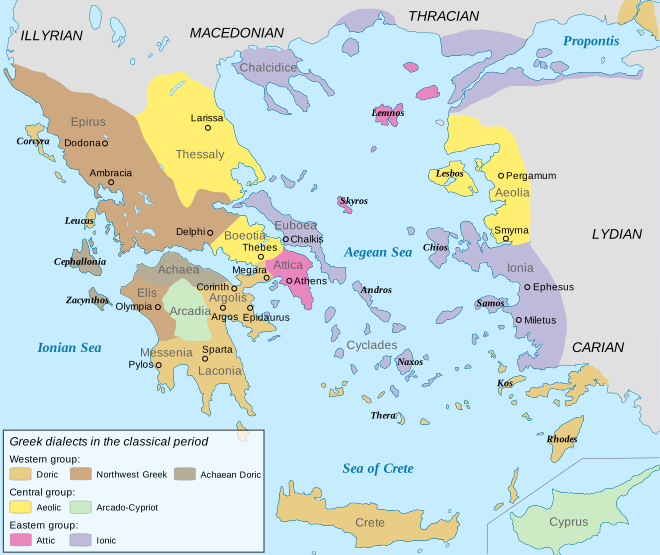

 Σε πείραξε η μαγειρίτσα ;
  Μάθε λοιπόν πως στον Μεσαίωνα οι κυρίαρχες ομάδες της Ανατολίας ήταν οι Έλληνες και οι Αρμένιοι . Υπήρχαν και ολιγαριθμότεροι Άραβες, Αραμαίοι , Ιρανοί , Καυκασιανοί κ.α. Οι Φρύγες είχαν εξαφανισθεί απ' τον 7ο αι. μ.Χ. τουλάχιστον. Οι τελευταίοι Λούβιοι ηταν οι Ίσαυροι , οι οποίοι εξαφανίστηκαν και αυτοί την Μεσοβυζαντνή Περίοδο.
 Δεν πειράζει. Μαζί μου θα μάθεις πολλά.


